Saturday, September 24, 2011

RUBYVALE - POPULATION: 510

THURSDAY 22.9.2011: First tourist stop - on your way to Rubyvale, the Tropic of Capricorn which runs right by the Tin Shed Bottle Shop. Yes, in the middle of what appears to be nowhere was the Tin Shed Bottle Shop and yes we stopped there also! Then a short drive to Rubyvale and the Miners Heritage. This is a commercial operation which conducts guided tours through Australia's largest underground sapphire mine. 
Finished the day at Monique's Mine -a fossicking park that takes you through the washing and identifying process involved with finding your own sapphires and zircons.
SEEKING THE BIG ONE!


Rubyvale is a town approximately 61 kilometres west of Emerald. Situated in a region called the Gemfields, sapphires are mined extensively in the area.

SAPPHIRE - POPULATION: 550

OUTSIDE THE CARAVAN PARK
WEDNESDAY 21.9.2011: Arrived in Sapphire - now this is what we are talking about. It is the type of place where you could disappear from the radar without a trace! We are staying at Blue Gem "The Friendly" Caravan and Tourist Park.
Recently the park has topped up the internal road with wash (gravel from an ancient river bed which can carry sapphire and zircon), from a local mine. As you travel the road you are invited to fossick. Whenever Carole cannot be found no guesses as to where she is - she has even acquired a mentor! Ron came to Sapphire for a week and twelve months later he is still here.
 
MENTOR RON & STUDENT!

EMERALD - POPULATION: 10,999

TUESDAY 20.9.2011: The still naive travellers pulled into the rather large town of Emerald. We had expected a somewhat smaller village! Emerald is a large, modern country town that was established in 1879 as a base for the building of the western railway. The town is named after 'Emerald Downs Hill', a lush green hill located just north of town. We headed for the Freedom Camp "in the car park under the bridge outside the Botanic Gardens". Arrived at 4.00pm, no-one in sight, changed position twice, speculated about our safety and finally decided that we were close enough to town to dial 000 if need be. 4.05pm motorhomes and caravans as far as the eye could see!

Wednesday, September 21, 2011

THERESA CREEK DAM

WHAT WE HAD EXPECTED
MONDAY 19.9.2011: The information read "Camp spot 22 km SW of Clermont. See Caretaker." Sounded idealic, our sort of retreat - driving along our expectations rose, then we arrived! Car park was full, boat ramps, marinas, caravans as far as the eye could see, amenities and an enormous playground just packed with children. There was water skiing, boats speeding with the kids being towed screaming behind and oh by the way, school holidays have just started! As it had taken time to travel and it only cost $10.00 per night we stayed the two nights.
REALITY!
Theresa Creek Dam was constructed by the Blair Athol Coal Project in 1983. Built to ensure a reliable water supply for Clermont, the lake behind the dam wall covering an impressive 300 hectares. We made our way to "the other side" of the dam where car port like structures have been erected. Select one that is vacant, park and take up residence - excellent idea!


Tuesday, September 20, 2011

CLERMONT - POPULATION: 1,854

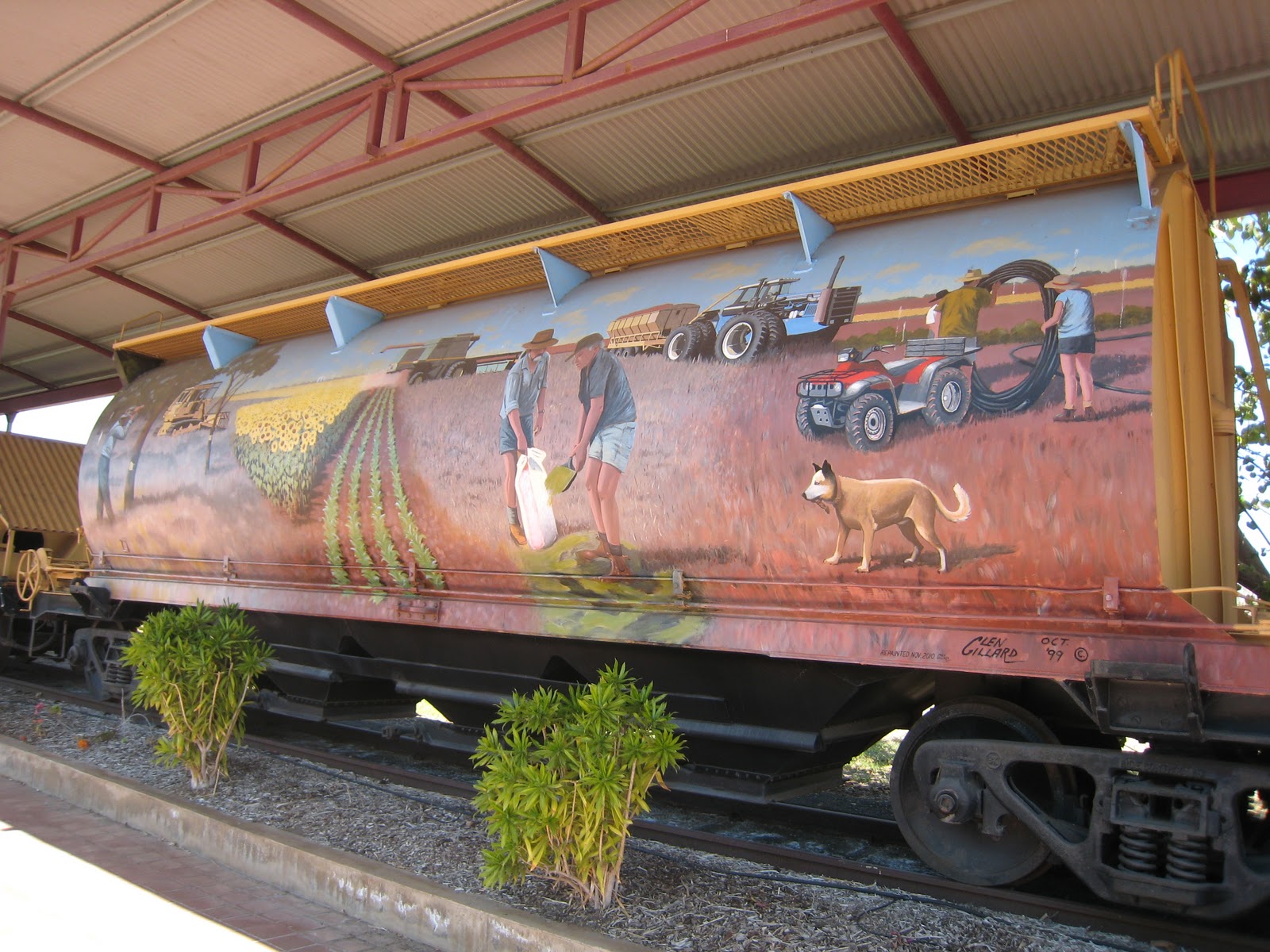
CARRIAGE FROM THE RAIL WAGON MURALS PROJECT
SUNDAY 18.9.2011: Ludwig Leichhardt was the first European to pass through the Clermont area in 1845, but it was the discovery of gold in 1861 that was responsible for the establishment of the town. The town reserve was proclaimed on 25 March 1864. It is named after Clermont-Ferrand, France. Copper was discovered soon after. In the 1880s up to 4000 Chinese people were resident in Clermont, mining for gold and copper. This led to racial riots and the Chinese were removed from the region in 1888. The railway was extended north from Emerald to Clermont in February 1884. However, no passenger trains are available to or from Clermont.
The town was originally established on low lying ground next to a lagoon or billabong, but flooding was always a problem, with four substantial floods occurring between 1864 and 1896. The greatest flood, in 1916, killed 65 people out of a town population of 1,500 and remains one of Australia's worst natural disasters in terms of life lost. Following the 1916 flood, many of the wooden buildings of the town were moved using steam traction engines to a new town site on higher ground. A local amateur photographer, George Pullar took numerous photographs of the moving buildings, published in the 1980s as "A Shifting Town". Today, Clermont is a major hub for the large coal mines in the region as well as serving agricultural holdings.
Rio Tinto is currently constructing the Clermont Mine, located 12 kilometres (7.5 mi) northwest of the township of Clermont in central Queensland. When the mine reaches full capacity (expected in 2013) it will produce up to 12.2 million tonnes of thermal coal for international markets.

We jumped into Poodle Palace and headed for Theresa Creek Dam.

BELYANDO CROSSING - POPULATION: 5

SATURDAY 17.9.2011: Needed to stop for petrol on what was to be one of our longer driving days. Pulled into the Belyando Crossing Service Station.
There was a small motel and spaces for caravans at the back. The 'Dog Policy' was fairly evident. Carole asked "I suppose this would be a silly question, but can we stay the evening given we have dogs?" Response "not a problem." Now know the meaning of mixed messages!


CHARTERS TOWERS - POPULATION: 7,979

MUNICIPAL LIBRARY
FRIDAY 16.9.2011: Stayed the night at Charters Towers Tourist Park. 'The World' as it is known, is a scenic gold mining city. From a chance discovery of gold in 1872 by a young Aboriginal horse boy, Charters Towers soon turned into a bustling metropolis. At the height of the gold rush the town included 11 crushing mills, 65 hotels and one of the very first regional Stock Exchanges in Australia. The 'One Square Mile' takes in the city's heritage listed World Theatre, City Hall and the Post Office. 
TOWERS HILL
Once a significant allied military base in WW11, Towers Hill pays testament to this with some 30 concrete bunkers dotted throughout the surrounding hills.
TOWERS HILL AMPITHEATRE